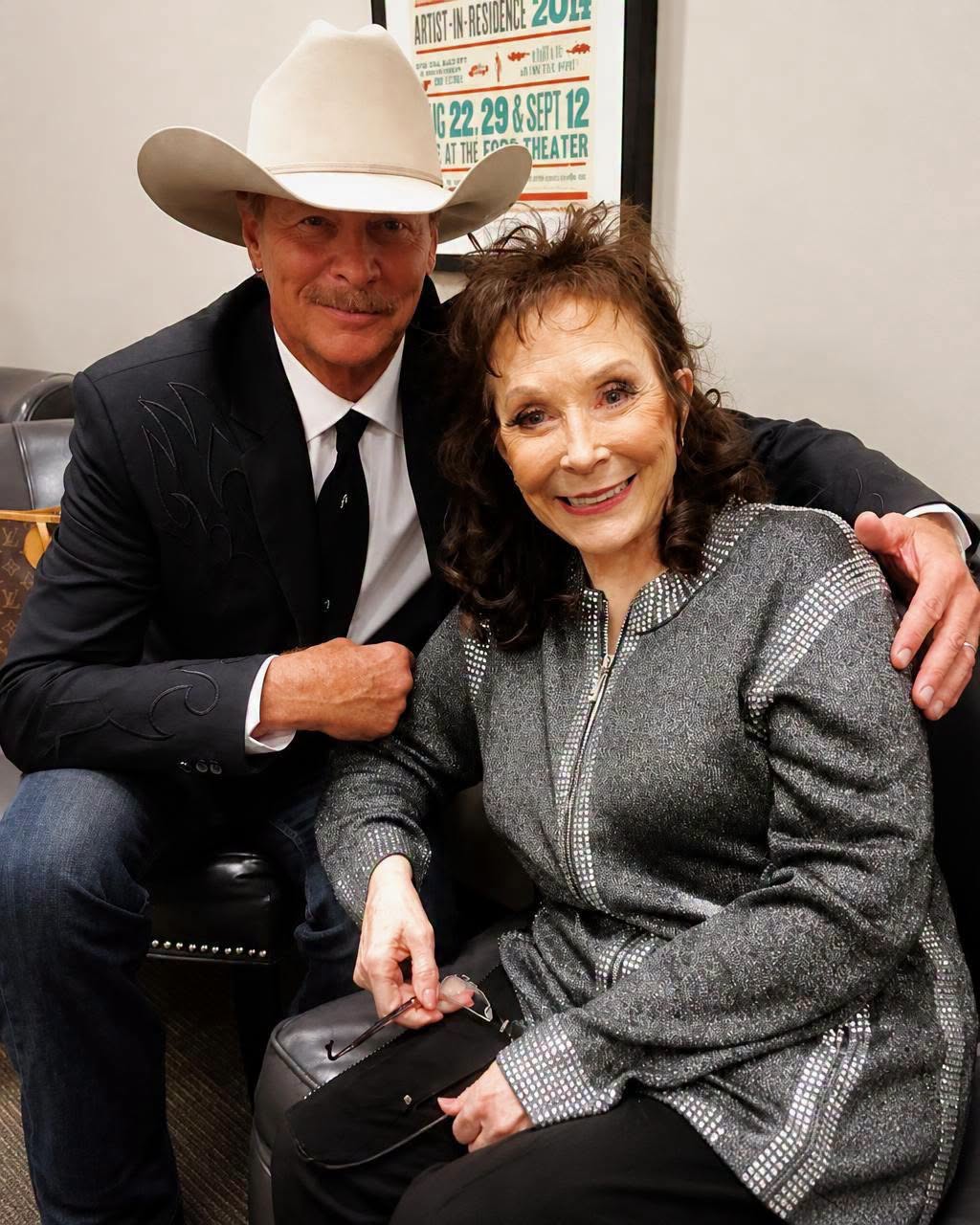
On October 30, 2022, the biggest names in country music filled the Grand Ole Opry House to say goodbye to Loretta Lynn. One by one, they sang her songs. Then Alan Jackson sat down on a stool with an acoustic guitar and did something different. He did not sing a Loretta Lynn song. He sang the one he had written for his own mother’s funeral.
To understand why, you have to go back five years, to a night when Loretta Lynn did something for Alan Jackson that she could easily have skipped.
The Woman Who Sang About Real Life
Loretta Lynn died peacefully in her sleep on October 4, 2022, at her home in Hurricane Mills, Tennessee. She was 90 years old. For six decades, the coal miner’s daughter from Butcher Hollow, Kentucky, had sung about things country radio was often afraid to touch: cheating husbands, hard marriages, women who were tired of being pushed around, and even birth control. When she released “The Pill” in 1975, a number of radio stations refused to play it.
She never pretended her life was prettier than it was. That honesty is what made millions of women feel seen, and it is what made the musicians who followed her love her so deeply.
A Hard Year for Alan Jackson
In January 2017, Alan Jackson lost his mother, Ruth Musick Jackson. Everyone called her Mama Ruth. She was 86 and died at her home in Newnan, Georgia, the same house where Alan Jackson and his four sisters grew up.
Alan Jackson had already turned grief into song once before. When his father died in 2000, he wrote “Drive (For Daddy Gene).” For his mother, he wrote “Where Her Heart Has Always Been,” and he sang it at her funeral. Years later he recorded it for his 2021 album Where Have You Gone. After the track was already mixed, one of his sisters found an old recording of Mama Ruth reading from the Bible. They put her voice at the very beginning of the song.
The Night Loretta Lynn Left the House
That same year, Alan Jackson was chosen for the Country Music Hall of Fame. At the Medallion Ceremony in Nashville on October 22, 2017, tradition calls for an existing member to welcome each new one. Alan Jackson asked for Loretta Lynn.
There was a problem. Loretta Lynn had suffered a stroke that May, and she had been at home recovering ever since. Alan Jackson knew that when he asked. She came anyway. George Strait and her daughter Patsy helped her to the podium, and the room rose to its feet. She told the crowd she had not been out of the house since the stroke. Then she looked at Alan Jackson and said:
“You’re the only thing that would’ve brought me here.”
She remembered the first time she met him, back when he seemed like a scared young man, and how she told him he would become one of the great singers in country music. She told him he hadn’t let her down. When Alan Jackson finally reached the microphone, he said Loretta Lynn had told him he belonged in the Hall of Fame.
Twenty-Six Days Later
The memorial at the Opry House was called Coal Miner’s Daughter: A Celebration of the Life & Music of Loretta Lynn, and it aired live on CMT. George Strait, Brandi Carlile, Keith Urban, Tanya Tucker, Wynonna and many others were there. Margo Price sang “The Pill.” The Highwomen closed the night with “Coal Miner’s Daughter.”
When it was Alan Jackson’s turn, he thanked Loretta Lynn’s family for letting him sing “Where Her Heart Has Always Been.” He explained that Loretta Lynn had always reminded him of his mother. Both women, he said, were outgoing, sweet and genuine, and would tell you exactly what was on their minds.
Then he played. A fiddle and a second guitar came in quietly behind him. There was no big production, just a man on a stool singing the most private song he owned. By the end, his eyes were glassy.
Why It Mattered
Any of Loretta Lynn’s hits would have been a fine tribute. But Loretta Lynn had spent her whole life handing strangers the most personal parts of her own story. In 2017, she gave Alan Jackson something personal too: her first trip out of the house after a stroke, made just for him.
Five years later, Alan Jackson answered in kind. He gave her the song he wrote for the woman who raised him. It was his way of saying that Loretta Lynn had been family, too.