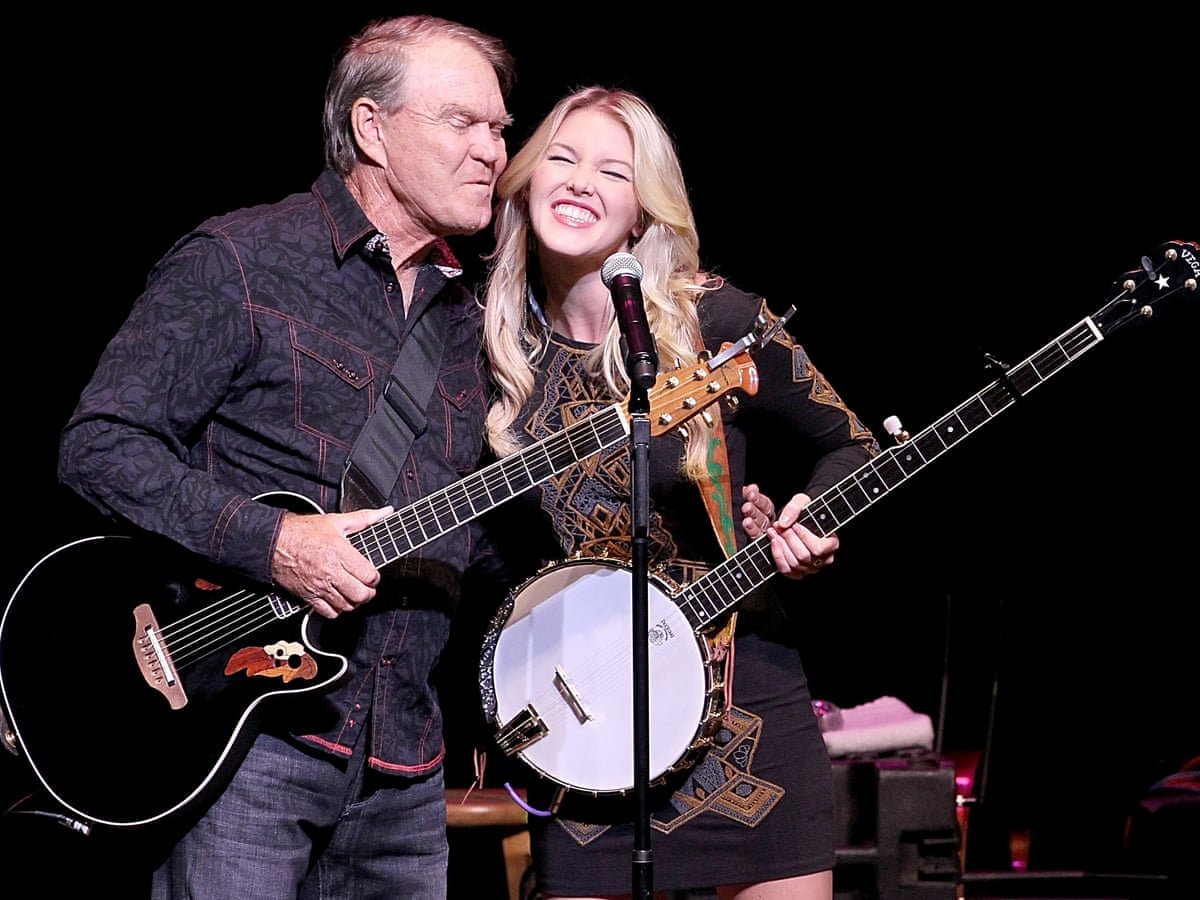
Glen Campbell gave country music some of its most familiar voices and melodies. Rhinestone Cowboy. Wichita Lineman. Gentle on My Mind. By the time he reached his seventies, he was a member of the Country Music Hall of Fame with decades of performances behind him. But one of the most moving chapters of his life was not written by Glen Campbell at all. It was written by his daughter, Ashley Campbell, and it all came down to a single promise.
The Diagnosis He Chose Not to Hide
In June 2011, Glen Campbell told the world he had been diagnosed with Alzheimer’s disease. Many artists in his position would have stepped away quietly. Glen Campbell did the opposite. He went back on the road for what became known as the Goodbye Tour, a run of shows through 2011 and 2012 that let audiences say farewell while he could still stand on a stage and play.
He did not do it alone. His daughter Ashley Campbell, then in her mid-twenties and only a couple of years out of college, joined his band on banjo and keyboards. Night after night, she stood a few feet from her father under the lights.
The Last Duet
One of the highlights of those shows was a musical back-and-forth between father and daughter. Glen Campbell played guitar, Ashley Campbell answered on banjo, and the two traded runs in front of the crowd. Audiences loved it. For Ashley Campbell, it was also a way to measure something no one else in the room could see.
Over time, it became harder for her father to keep pace with her. Some nights the lyrics were difficult for him to find. Yet she also noticed how naturally he could recover when he lost his place, and how certain songs stayed with him longer than almost anything else. The stage, she later said, still felt like home to him.
A Fear Said Out Loud
On April 24, 2013, Ashley Campbell sat before the U.S. Senate Special Committee on Aging in Washington, D.C. Her father, then 77, sat beside her. She spoke about the millions of American families living with Alzheimer’s and urged lawmakers to support research funding.
Then she said something far more personal. She explained that her father now struggled to keep up when they played together, and that he had trouble remembering her name. She admitted that her deepest fear was that one day he would look at her and she would mean nothing to him.
“I will be absolutely nothing to him.”
It is hard to imagine saying those words in a hearing room, with the person you are describing sitting right next to you.
The Song She Wrote
Ashley Campbell’s answer to that fear was a song. She began writing it at the family home in Malibu after the tour ended, and finished it in Nashville with her co-writer Kai Welch. She called it Remembering.
The song opens with a memory from her early childhood, a small moment between a little girl and her father. From there, it moves to the present, where the roles have quietly reversed. The man who once looked after her now needs her to look after him.
The Promise
At the heart of Remembering is a promise. Ashley Campbell tells her father that he does not have to worry about the memories slipping away. She will hold on to them for both of them. Whatever he forgets, she will remember for him.
It is a simple idea, and that is why it hits so hard. She could not stop the disease. She could not bring back what it took. But she could make sure that the moments they shared would not disappear, even if he could no longer carry them himself. She has said she learned to love every new version of her father that Alzheimer’s brought along.
Remembering became part of the documentary Glen Campbell: I’ll Be Me, which followed his final tour. In 2015, it was released as her debut single. She also played banjo on her father’s last studio album, Adiós.
What Remains
Glen Campbell died on August 8, 2017, at the age of 81. Alzheimer’s took many things from him in those final years. It did not take the nights on stage with his daughter beside him, or the song she wrote so those nights would never be lost.
Ashley Campbell kept her promise. Every time Remembering is played, she is still doing the remembering for both of them.