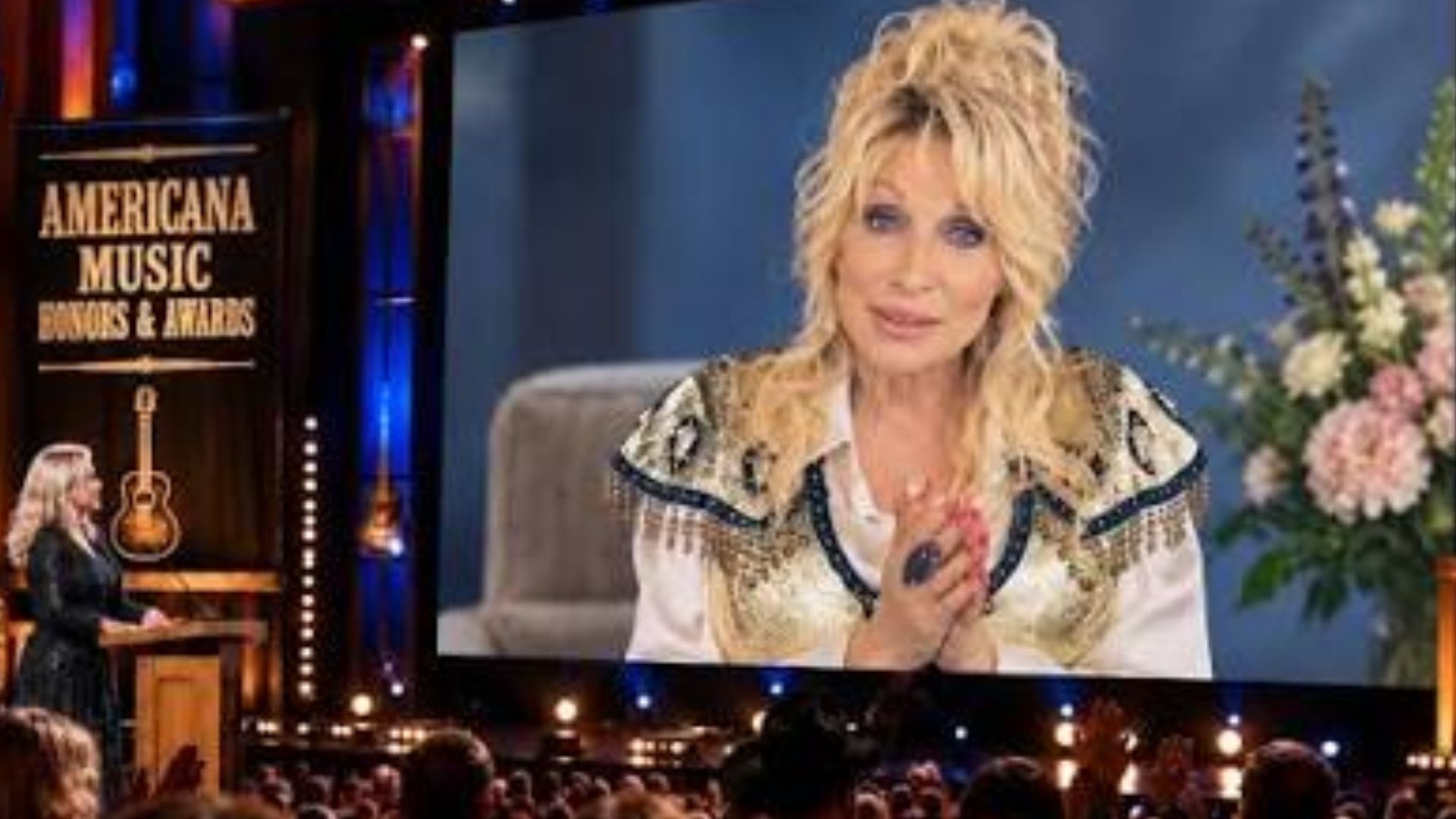
On the night of September 16, 2026, the Ryman Auditorium in Nashville was full for the Americana Music Honors & Awards. Three weeks earlier, on August 25, Dolly Parton had died at 80. Everyone in the room knew she would be honored that night. Almost no one expected to hear her voice.
An Award She Knew Was Coming
The Americana Music Association had chosen Dolly for its Lifetime Achievement Award. She had already recorded a video thank-you for the ceremony. She had not planned to attend in person, and in her final months she had been open about slowing down. In an interview with People just four days before she died, she said she would still do special performances but would not tour the way she used to.
So the video was never meant to be a goodbye. It was meant to be a thank-you from a woman who fully expected to be watching from home.
Emmylou Harris Took the Stage
The award was presented by Emmylou Harris, one of Dolly’s oldest friends in music. The two of them, along with Linda Ronstadt, made the Trio album in 1987, one of the most beloved harmony records in country history.
Emmylou spoke about Dolly’s gifts as a writer, a performer and a giver. She reminded the crowd of Dolly’s own simple advice to dream more, learn more, care more and be more. Then she said something that set up what came next: the video still carried “the same warmth, joy, and sparkle” Dolly had always shared.
“Well, Hey, It’s Dolly”
The lights went down and the screen came up. When that familiar voice said, “Well, hey, it’s Dolly,” people in the audience gasped out loud, then broke into cheers.
In the message, Dolly talked about the music she grew up with in the Smoky Mountains of East Tennessee. What people now call Americana, she explained, was simply the roots music she played as a girl. She also looked back on the acoustic and bluegrass albums she made later in her career, and said those projects changed the course of her work.
It was pure Dolly: warm, funny and humble, talking about her music as if it had been a lucky accident rather than one of the great careers in American music.
The Same Stage Where It Started
There was a reason the moment hit so hard in that building. The Ryman was the home of the Grand Ole Opry for three decades, and in 1959 a 13-year-old Dolly Parton stepped onto that stage for her Opry debut. Johnny Cash introduced her. The crowd called her back for three encores.
Sixty-seven years later, the same room heard her once more, this time from a screen, in a video recorded by a woman who didn’t know it would be her farewell.
“Just Know That I Will Always Love You”
Dolly closed the message with a line that could only come from her: “Just know that I will always love you.”
She first wrote those words in 1973, in a song about leaving her longtime duet partner Porter Wagoner to go out on her own. It was a goodbye song from the start, written with gratitude rather than bitterness. It became a number one hit for her, and years later a worldwide smash for Whitney Houston. At the Ryman, it became something else: the last thing Dolly Parton said to a room full of people who loved her.
The whole hall rose to its feet.
A Song for the Road Home
After the video, Brandi Carlile joined the trio I’m With Her, made up of Sarah Jarosz, Aoife O’Donovan and Sara Watkins, to sing “Coat of Many Colors.” It was the perfect choice. The song tells the story of a little girl in the Tennessee hills whose mother sews her a coat from rags, and who learns that being loved is worth more than being rich. Dolly always said it was one of the most personal songs she ever wrote.
Hearing it right after her own voice brought the night full circle, from the mountains she talked about, to the stage where she started, to the song that explained where she came from.
Why This Moment Will Stay With People
Dolly Parton spent more than six decades making strangers feel like friends. She never made a big show of saying goodbye, and in the end she didn’t have to. She had already recorded the words, thanked the people who mattered, and closed with the line she had been singing to the world since 1973.
Three weeks after she was gone, Dolly still got the last word. And it was exactly the word she would have chosen.