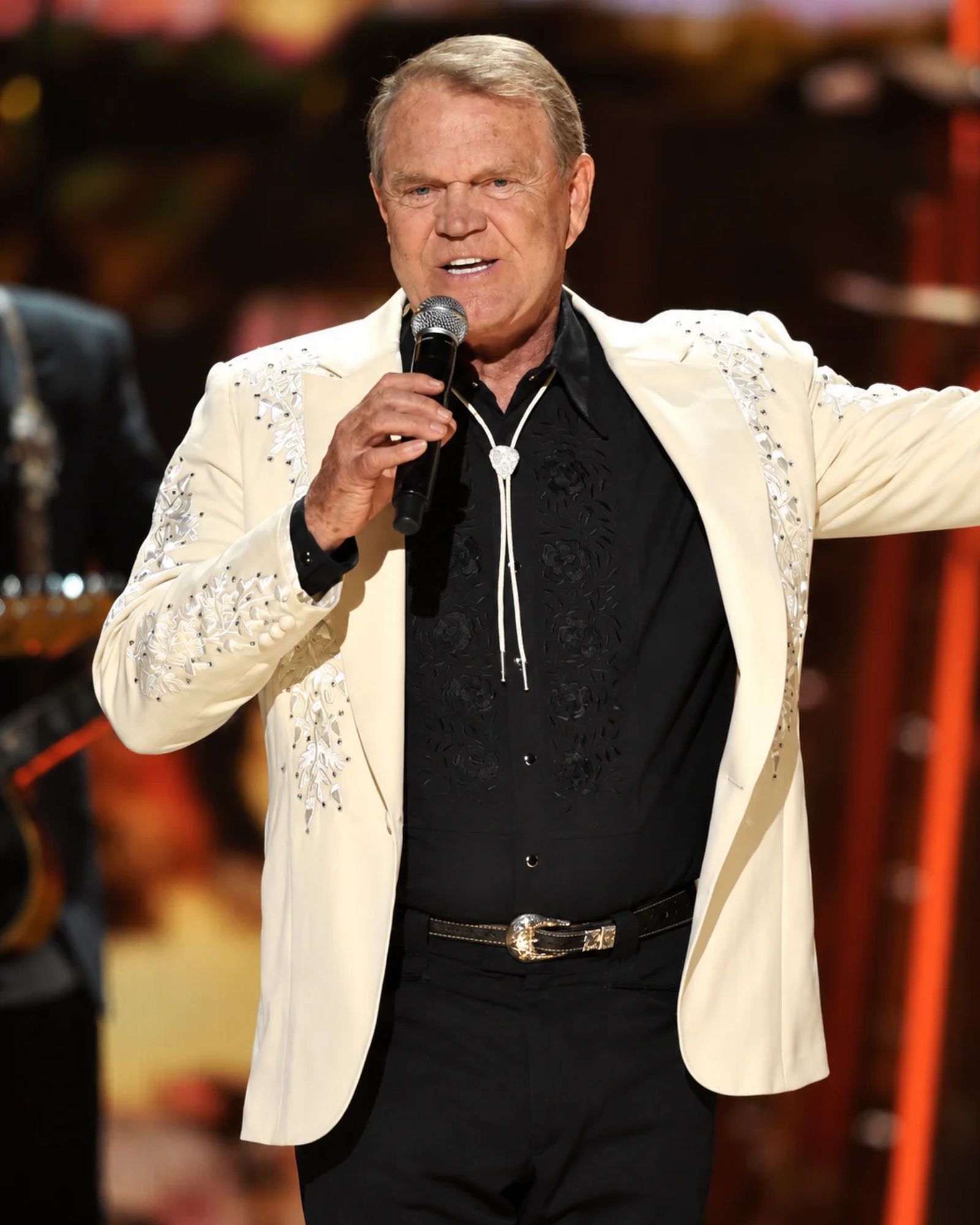
When Glen Campbell was buried in a small Arkansas cemetery, one simple word on a ribbon told a story that no award or hit record ever could.
It wasn’t “Legend.” It wasn’t “Rhinestone Cowboy.” The ribbon on a large floral arrangement beside the fresh grave said “Brother.”
Glen Campbell died on August 8, 2017, at the age of 81, in Nashville, Tennessee. After a remarkable career that had taken Glen Campbell from rural Arkansas to television screens and concert stages around the world, the final journey led back to the little community where everything began.
From a Five-Dollar Guitar to Country Music History
Glen Travis Campbell was born on April 22, 1936, in Billstown, Arkansas, a tiny community near Delight. Glen Campbell was one of twelve children born to John Wesley Campbell and Carrie Dell Stone Campbell.
The family worked the land, growing cotton in the sandy soil of Pike County. Money was scarce, but music was part of everyday life.
Years later, Pike County Judge Dewight Mack recalled that Glen Campbell’s father had purchased a guitar from Sears for approximately five dollars. That inexpensive instrument helped begin one of the most extraordinary musical careers Arkansas would ever produce.
Glen Campbell eventually became a sought-after session guitarist in Los Angeles before finding enormous success as a singer. Songs including “Gentle on My Mind,” “Wichita Lineman,” “By the Time I Get to Phoenix,” and “Rhinestone Cowboy” introduced Glen Campbell to millions of listeners.
But back in Pike County, people remembered something else: the young man whose love of playing guitar had been obvious long before fame arrived.
Why Glen Campbell Was Buried in Billstown
On Wednesday, August 9, 2017, just one day after Glen Campbell’s death, a private family burial took place at Campbell’s Cemetery in Billstown.
The family’s public announcement identified the burial location as Glen Campbell’s hometown of Delight, Arkansas. But residents of southwest Arkansas knew the more precise location: Billstown, the small community where Glen Campbell had actually been born.
Several days after the burial, Arkansas writer Rex Nelson traveled through the area with Paul Austin. Hoping to find the grave, the two followed a country road until they discovered a mailbox bearing the Campbell name.
Not far beyond it stood the family cemetery.
There, behind the headstone of Glen Campbell’s parents, Carrie and John Wesley Campbell, was the freshly prepared grave.
A large floral arrangement from a Murfreesboro florist stood at its head. Across the flowers was the ribbon bearing that single word: “Brother.”
For fans who remembered the Grammy Awards, the television appearances, and the unmistakable voice, the scene offered a different perspective. Glen Campbell was not simply a famous entertainer returning to Arkansas. Glen Campbell was a member of a family, resting close to the people who had been there at the beginning.
The Family Returned Nearly a Year Later
Yet the family’s farewell did not end with the burial in August 2017.
On August 1, 2018, nearly one year after Glen Campbell’s passing, relatives gathered again at Campbell’s Cemetery for the placement of a permanent headstone.
Glen Campbell’s widow, a daughter, brothers, sisters, and other family members attended the quiet ceremony.
The headstone had been prepared in Memphis, Tennessee. Glen Campbell’s nephew Steve Campbell, who attended the gathering, later expressed the family’s satisfaction with the finished memorial.
Then came a moment that connected the family’s personal grief with the musical tradition that had shaped Glen Campbell’s life.
At the suggestion of Glen Campbell’s sister, Jane Rather, the gathered relatives sang “Amazing Grace.”
There was no television audience and no concert crowd. Just family members together in the Arkansas community where Glen Campbell’s story had begun.
After decades of hearing Glen Campbell sing for audiences around the world, the family marked this moment by singing together.
The Music That Continued at the Cemetery
Even the placement of the headstone was not the final chapter in the story of Glen Campbell’s resting place.
By October 2023, visitors to Campbell’s Cemetery could encounter something unusual: a loudspeaker mounted on a tree, playing Glen Campbell’s songs on repeat.
The feature was documented by the Encyclopedia of Arkansas, offering a remarkable image of the singer’s lasting connection to Billstown.
Glen Campbell had traveled far beyond the cotton fields of Pike County. The music reached radio stations, recording studios, movie theaters, and homes across generations.
And years after Glen Campbell’s death, that familiar voice was being heard again in the small Arkansas cemetery where the singer had been laid to rest.
More Than a Rhinestone Cowboy
Millions will always remember Glen Campbell for the songs. Others will remember the extraordinary guitar playing or the easygoing television personality who welcomed families into living rooms every week.
But perhaps one of the most meaningful reminders of Glen Campbell’s life can be found in Billstown.
It is the grave near the headstone of John Wesley Campbell and Carrie Campbell. It is the family gathering where “Amazing Grace” was sung. And it is the music playing among the trees.
Most of all, it is that one word on a ribbon in August 2017.
Before Glen Campbell belonged to the world, Glen Campbell belonged to a family.
And in the end, that was how the family remembered Glen Campbell.