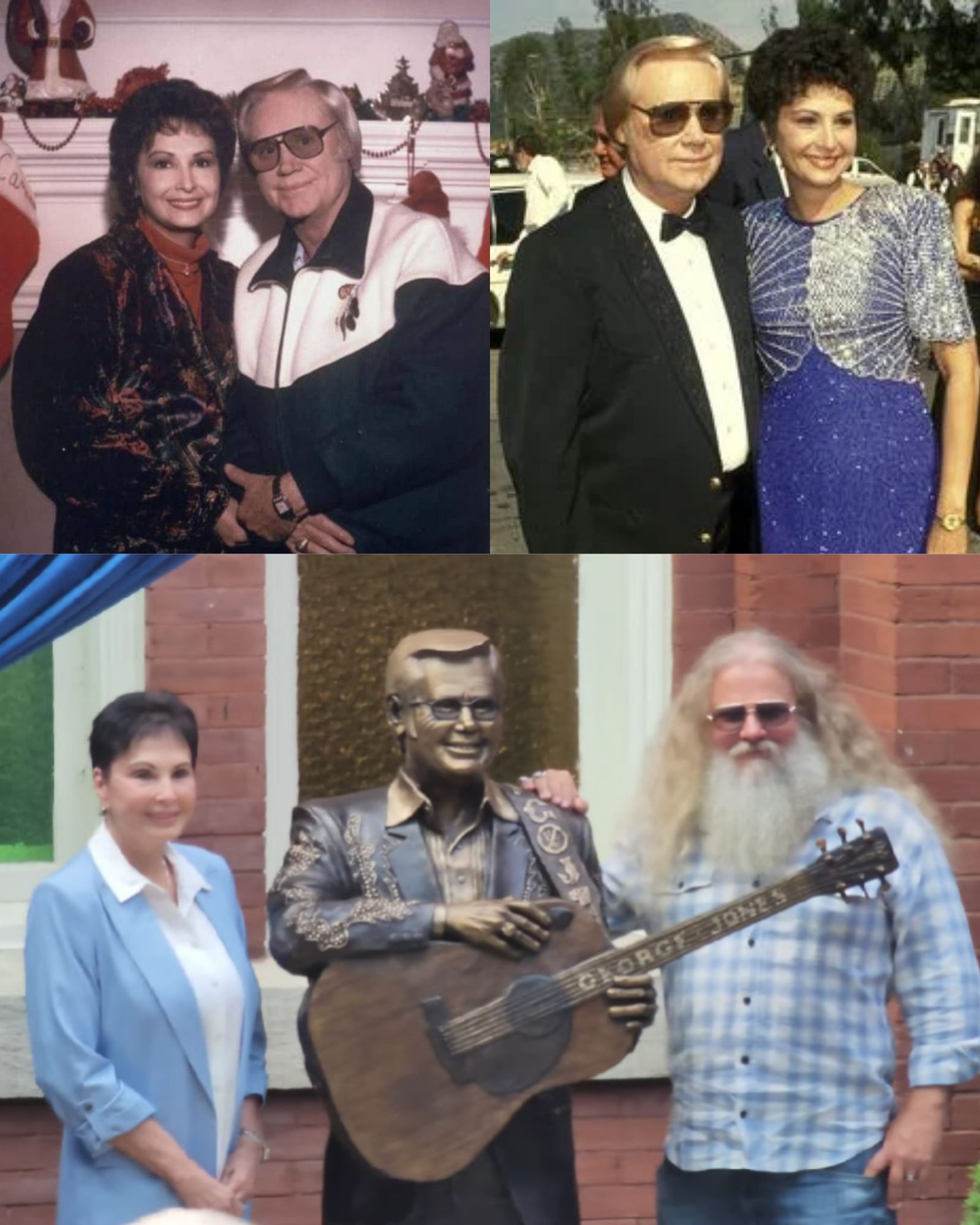
George Jones spent decades singing about heartbreak, regret, and second chances. But according to Nancy Jones, there was one place in Nashville where the country legend always seemed to follow a different set of rules.
It wasn’t a recording studio or a place George Jones visited privately. It was the Ryman Auditorium, one of the most historic stages in country music.
On June 3, 2025, more than twelve years after George Jones died, Nancy Jones returned to the Ryman for the unveiling of a bronze statue honoring her husband. During the ceremony, Nancy shared a memory that revealed just how much that building had meant to George Jones.
For a man whose struggles with alcohol had become part of his public reputation, the Ryman was different.
The Place George Jones Treated Differently
Longtime country fans remember the nickname “No Show Jones.” During some of the most difficult years of his career, George Jones missed scheduled performances, disappointed audiences, and faced personal problems that threatened both his career and his life.
Those troubles were well documented, and George Jones eventually spoke openly about them. But Nancy Jones knew another side of the singer, one that rarely received as much attention as the stories about missed concerts.
Speaking at the Ryman statue unveiling, Nancy explained that George Jones had a special understanding of what it meant to perform inside that building.
“When he played there, he didn’t believe in having a drink.”
That was how Nancy Jones remembered it.
In fact, Nancy said she wished George Jones could have worked at the Ryman every weekend. She recalled that George delivered some of his finest performances there, where the history of the building seemed to command a particular kind of respect.
George Jones regarded the Ryman as the Mother Church of Country Music. To George Jones, that description meant something.
It was more than a famous venue. It was a place associated with the singers and musicians George Jones had admired since childhood.
Why the Ryman Meant So Much to George Jones
George Jones grew up listening to the Grand Ole Opry on the radio. Like countless young musicians across the South, George Jones heard the voices coming out of Nashville and dreamed of becoming part of that world.
In 1956, George Jones became a member of the Grand Ole Opry. At the time, the Opry was still broadcasting from the Ryman Auditorium, where it had been based since 1943.
For George Jones, performing on that stage meant joining a tradition that had shaped his understanding of country music.
The Ryman was known for its remarkable acoustics, its wooden pews, and the generations of performers who had stood before its audiences. Nancy later recalled that George Jones particularly loved the sound of the room.
That history gives Nancy’s revelation its real significance.
George Jones could be unpredictable elsewhere, particularly during the troubled periods of his life. But according to the woman who knew George Jones better than almost anyone, the Ryman brought out a different sense of responsibility.
Nancy wasn’t describing a perfect man. Nancy was remembering a particular place where George Jones’s respect for country music showed itself in a very personal way.
Twelve Years Later, Nancy Jones Returned With a Special Purpose
When Nancy Jones arrived at the Ryman Auditorium on June 3, 2025, George Jones had been gone since April 26, 2013.
That day’s gathering included family members, longtime friends, music industry figures, and fellow country singer Jamey Johnson. They had come to celebrate a new bronze statue created by sculptor Ben Watts.
Nancy Jones had helped with the project by sharing photographs, clothing, and personal details that would allow the statue to resemble the George Jones she remembered.
The finished sculpture included familiar details, from George Jones’s stage clothing and guitar strap to the rings George Jones wore.
During the ceremony, Ryman Hospitality Properties executive Colin Reed presented Nancy with an old photograph of George Jones performing on the very stage the singer had loved.
It was a fitting connection between the performer who once stood inside the building and the permanent tribute now standing outside.
The statue joined those honoring Little Jimmy Dickens, Bill Monroe, Loretta Lynn, and Charley Pride along the Ryman’s Icon Walk.
For Nancy Jones, the occasion was about more than a bronze likeness. It meant George Jones would have a lasting presence at a place that had always been important to him.
What Nancy Believed George Jones Would Have Said
After the statue was unveiled, Nancy Jones spoke about how pleased George Jones would have been to receive the honor.
Nancy even imagined the simple, affectionate response George Jones might have given upon seeing himself standing outside the historic auditorium.
“Well, honey, I finally made it.”
Those were Nancy’s imagined words, not something George Jones had actually said. But coming from the woman who had shared so many years of his life, they carried a personal warmth that no formal tribute could quite reproduce.
George Jones had already earned his place among country music’s greatest singers long before the statue was unveiled.
Yet Nancy’s story offered fans something more intimate than another account of awards, hit records, or professional achievements.
It revealed how deeply George Jones respected the traditions of the music that made him famous.
And on a June afternoon in Nashville, Nancy Jones helped make sure that the connection between George Jones and the Ryman Auditorium would never be forgotten.