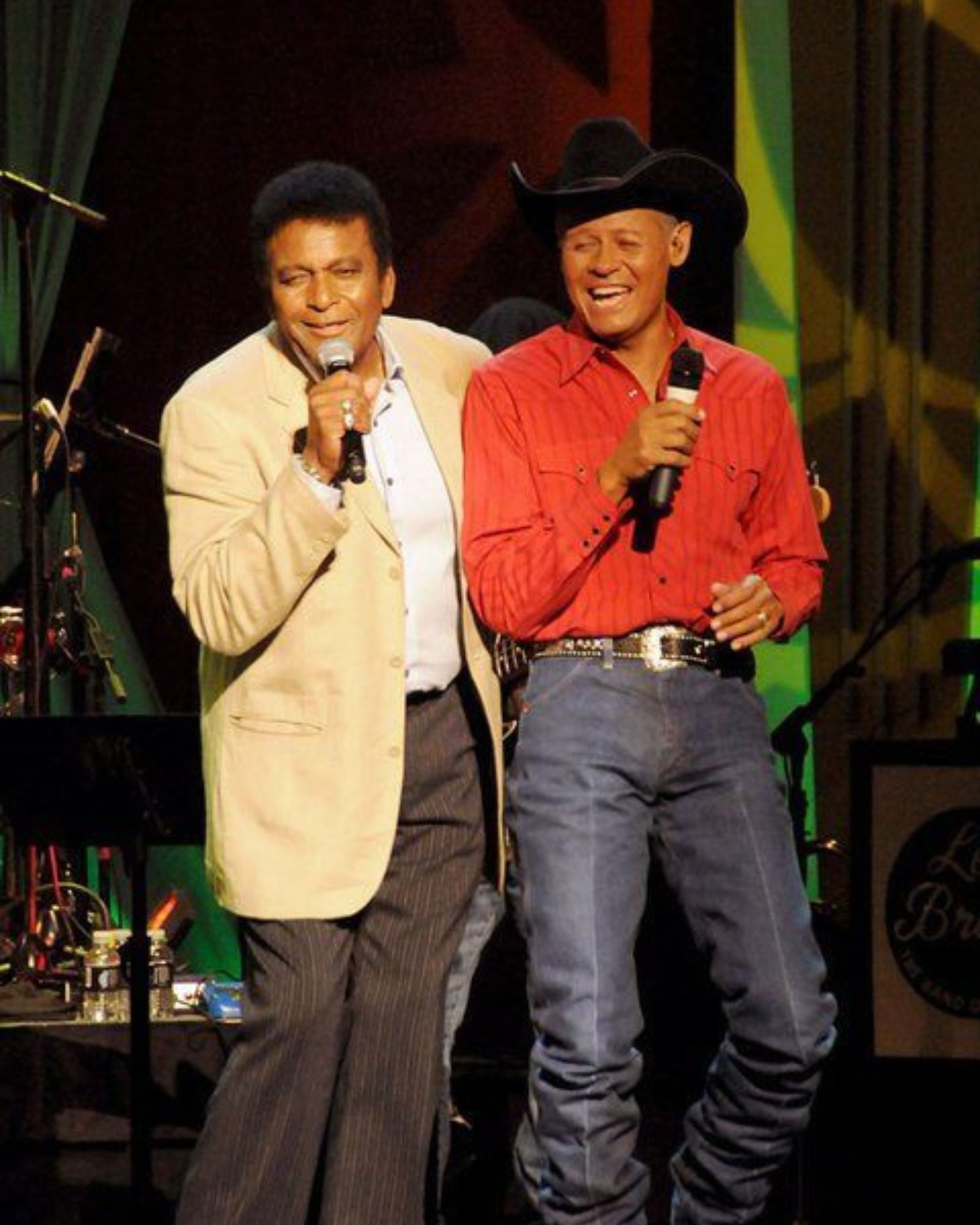
In 1965, a young Black singer from Mississippi was about to receive a recording contract from RCA Victor, one of the most powerful record labels in America. There was just one remarkable detail: the company’s executives had agreed to sign him before learning he was Black.
That singer was Charley Pride.
Less than a decade later, Charley Pride would become one of RCA’s biggest commercial successes. Among the label’s recording artists, only Elvis Presley sold more records during Pride’s extraordinary run.
For a man entering country music at a time when racial barriers still shaped the entertainment industry, that achievement was almost unimaginable.
From Mississippi Cotton Fields to Nashville
Charley Pride was born on March 18, 1934, in Sledge, Mississippi, the son of a sharecropper. Country music was part of his childhood. His father listened to the Grand Ole Opry, introducing the young Pride to performers such as Hank Williams, Ernest Tubb, and Roy Acuff.
Before pursuing music professionally, Charley Pride dreamed of becoming a baseball star. He played in the Negro Leagues and minor league baseball, eventually settling in Montana, where he worked and performed country songs whenever opportunities appeared.
Country singers Red Sovine and Red Foley encouraged him to pursue a career in Nashville. There, producer Cowboy Jack Clement recognized something special in his voice.
On August 16, 1965, Clement recorded demonstration songs with Pride at RCA’s Nashville studio. The recordings impressed legendary guitarist and record executive Chet Atkins.
Atkins traveled to Los Angeles and secured approval from RCA executives to sign Charley Pride. According to the Country Music Hall of Fame, Atkins revealed Pride’s race only after the agreement had been reached.
The music had earned him the opportunity. But the industry still had to confront its own expectations.
When Country Radio Heard a Voice Before Seeing a Face
RCA released Charley Pride’s first single, “The Snakes Crawl at Night,” in January 1966. Early promotional materials did not include the customary photographs of the singer.
Radio listeners heard a warm, unmistakably country voice. Many had no idea the performer was Black.
In 1967, his third single, “Just Between You and Me,” reached the country Top 10 and earned Charley Pride his first Grammy nomination.
But appearing before live audiences presented another challenge.
At an early major concert in Detroit, Charley Pride recognized that some audience members were surprised when he stepped onstage. He broke the tension by joking about appearing at a country show with a “permanent tan.”
The audience applauded, and he continued with the reason everyone had come: country music.
Charley Pride was not the first Black artist in country music. DeFord Bailey had been a celebrated Grand Ole Opry performer decades earlier. But Pride was becoming something the modern country recording industry had never seen on such a scale: a Black superstar with an extraordinary succession of mainstream hits.
The Hits That Made Charley Pride a Superstar
In July 1969, “All I Have to Offer You (Is Me)” became Charley Pride’s first No. 1 single on Billboard’s country chart.
Other major successes followed, including “Is Anybody Goin’ to San Antone,” “I’m Just Me,” and “Kiss an Angel Good Mornin’.”
The last became one of his signature recordings, spending five weeks at No. 1 on Billboard’s country chart and reaching No. 21 on the pop chart.
In 1971, Charley Pride won the Country Music Association’s Entertainer of the Year award, becoming the first Black performer to receive that honor. He also won Male Vocalist of the Year in 1971 and again in 1972.
Across his career, Pride achieved 29 Billboard country No. 1 singles, 52 country Top 10 hits, and three competitive Grammy Awards. His worldwide record sales exceeded 70 million.
These were not symbolic accomplishments. They represented decades of listeners buying records, requesting songs, and filling concert venues.
A Place in Country Music History
In 1975, Charley Pride co-hosted the CMA Awards alongside Glen Campbell, another landmark moment in his relationship with Nashville’s music establishment.
In 1993, Pride became a member of the Grand Ole Opry. Seven years later, in 2000, he became the first African American inducted into the Country Music Hall of Fame.
The honors continued. In 2017, the Recording Academy presented him with its Lifetime Achievement Award.
Yet perhaps one of the most meaningful moments came on November 11, 2020.
At the CMA Awards in Nashville, Charley Pride received the Willie Nelson Lifetime Achievement Award. Fellow country singer Jimmie Allen helped honor the legend, and the two shared a performance of “Kiss an Angel Good Mornin’.”
Nearly fifty years had passed since Charley Pride’s first CMA Entertainer of the Year victory.
On December 12, 2020, Charley Pride died at age 86.
His success did not erase every barrier in country music, and he had not been the first Black musician to contribute to the genre. But Charley Pride proved that a Black country singer could become one of Nashville’s biggest commercial stars, win its highest honors, and remain beloved across generations.
RCA had once introduced Charley Pride cautiously, without a publicity photograph. Before his career was over, the singer whose identity had been withheld from radio audiences had become one of the label’s greatest success stories—second only to Elvis Presley in record sales.
That is the history behind the voice that helped break country music’s color line.