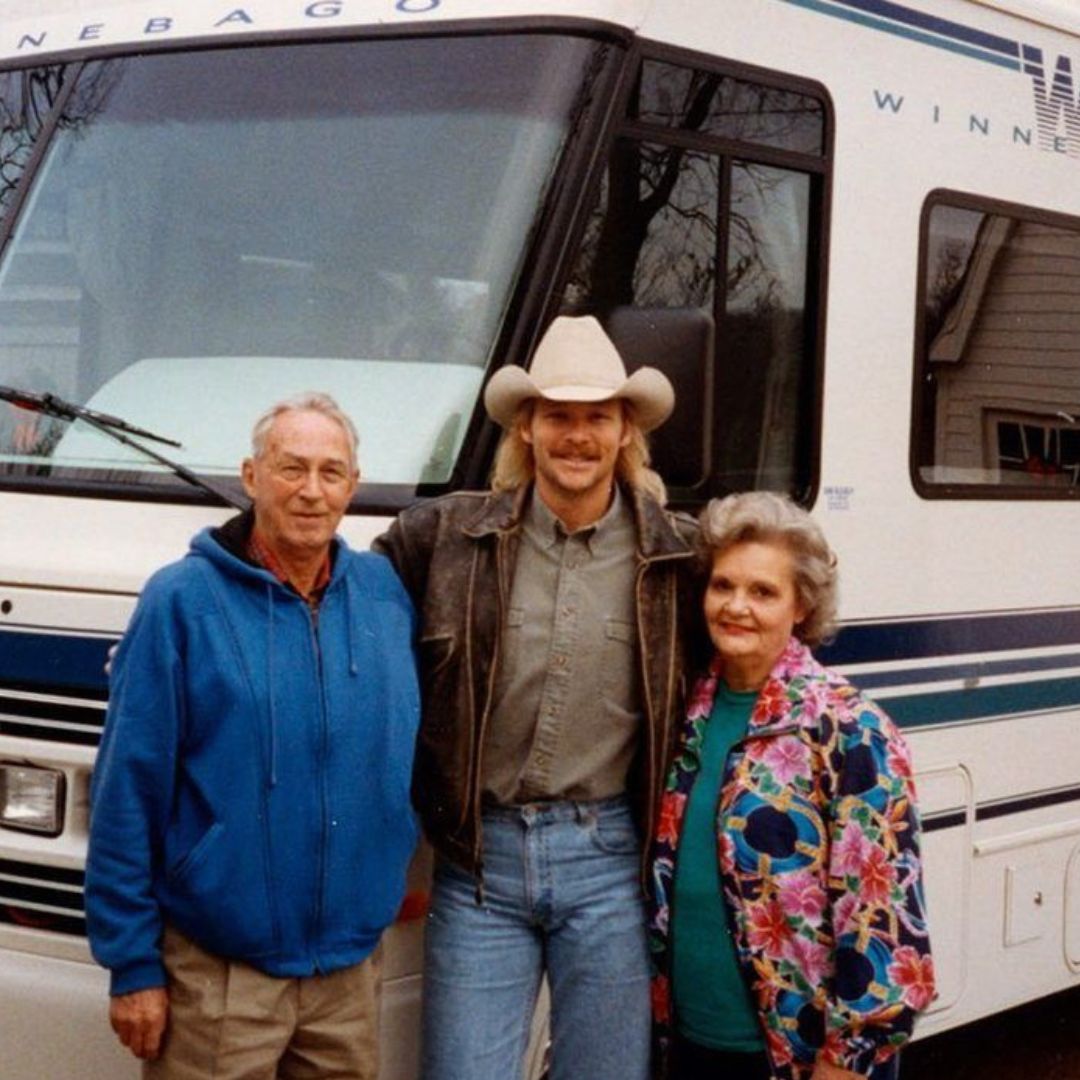
Long before Alan Jackson became one of country music’s biggest stars, his father brought home something that would quietly change his son’s life: a radio won in a drawing at work.
It wasn’t an expensive gift or a treasured family heirloom. Eugene “Daddy Gene” Jackson had simply won a General Electric radio while working at a Pepsi-Cola plant in Georgia.
Alan Jackson was about five years old at the time. Growing up in Newnan, Georgia, Alan Jackson listened to country music on that radio while his mother sang around the house.
Neither father nor son could have imagined that the same radio would one day inspire a hit song and become part of the collection at the Country Music Hall of Fame and Museum.
A Childhood Filled With Country Music
Alan Jackson grew up in a modest Georgia household where music was part of everyday life. His father worked hard to support the family, and his mother, Ruth Jackson, loved to sing.
The radio brought country music into their home, exposing young Alan Jackson to the sounds that would eventually shape his career.
Years later, those childhood memories remained remarkably clear.
Alan Jackson remembered his father winning the radio, his mother singing to the children, and the country songs that seemed to follow him wherever he went.
But becoming a country singer was a much harder journey than simply listening to one.
The Years When Alan Jackson Could Barely Make a Living
Before signing a record deal, Alan Jackson spent years playing small clubs and honky-tonks.
Alan Jackson traveled in an old Dodge van, sometimes driving all the way to Florida or Arkansas for a weekend of performances.
There were nights when Alan Jackson and his band played five or six sets. After paying the musicians and covering gasoline expenses, there was sometimes almost nothing left.
Alan Jackson watched other aspiring performers arrive in Nashville and seemingly find opportunities while he continued struggling to secure a recording contract.
Those difficult years became the foundation for a song that would eventually tell Alan Jackson’s own story.
The Song Idea Jim McBride Had Carried for Two Years
Songwriter Jim McBride had been carrying an unused song title in a notebook for approximately two years.
The idea was called Chasin’ That Neon Rainbow, Livin’ That Honky-Tonk Dream.
Jim McBride liked the title but had never found the right story to go with it.
Then Jim McBride sat down to write with Alan Jackson.
During their first songwriting collaboration, Alan Jackson began talking about the difficult years spent driving from town to town, playing small clubs, and hoping someone in Nashville would recognize his music.
Jim McBride realized that the title he had been saving perfectly described Alan Jackson’s experiences.
Alan Jackson also remembered the old radio his father had won and the way his mother used to sing to the family.
Those memories brought the song together.
The opening line was simple:
“Daddy won a radio”
For Alan Jackson, that wasn’t an invented country-music image. It was a real memory from childhood.
The finished song, “Chasin’ That Neon Rainbow,” became one of the most personal recordings on Alan Jackson’s debut album, Here in the Real World.
From a Georgia Childhood to the Billboard Charts
Released as a single in September 1990, “Chasin’ That Neon Rainbow” became one of Alan Jackson’s breakthrough hits.
The song reached No. 2 on Billboard’s country singles chart.
For listeners, it was an upbeat story about chasing a dream under the lights of country bars. For Alan Jackson, it was almost autobiographical.
The old radio, the songs his mother sang, the exhausting performances, and the years spent searching for a record deal were all drawn from real experiences.
And something unexpected happened after the song became successful.
Daddy Gene Found the Radio Again
After “Chasin’ That Neon Rainbow” became a hit, Eugene “Daddy Gene” Jackson found the old family radio and gave it to Alan Jackson.
In 1991, Alan Jackson donated the radio to the Country Music Hall of Fame and Museum.
It was a remarkable destination for something that had entered the Jackson household as a simple workplace prize.
The museum identifies the instrument as a General Electric model 11R22 AM/FM table radio, preserving a physical connection to the childhood that helped shape Alan Jackson’s music.
There was another piece of history worth saving, too.
When museum officials contacted Jim McBride about the original handwritten lyrics, Jim McBride explained that the pages were messy, full of the markings and revisions made during the writing process.
The lyrics had been written on four separate sheets of yellow notepad paper.
Museum officials wanted the originals exactly as they were. The handwritten pages became part of the museum’s archival collection.
Why That Old Radio Still Matters
In 2017, Alan Jackson himself was inducted into the Country Music Hall of Fame, joining the institution where his father’s radio had already been preserved for more than two decades.
That’s what makes this story so special.
A father won a radio at work. A little boy listened to country music on it. Years later, that boy grew up, struggled through countless nights on the road, and wrote a song about trying to become a singer.
The song became a hit, and the old radio became a piece of country music history.
For anyone who grew up listening to country music on a family radio, “Chasin’ That Neon Rainbow” is more than a story about becoming famous.
It’s a reminder of how ordinary family memories can stay with someone for a lifetime—and sometimes become the very songs that millions of people remember.