Chapter 1
The Envelope Beneath Her Clothes
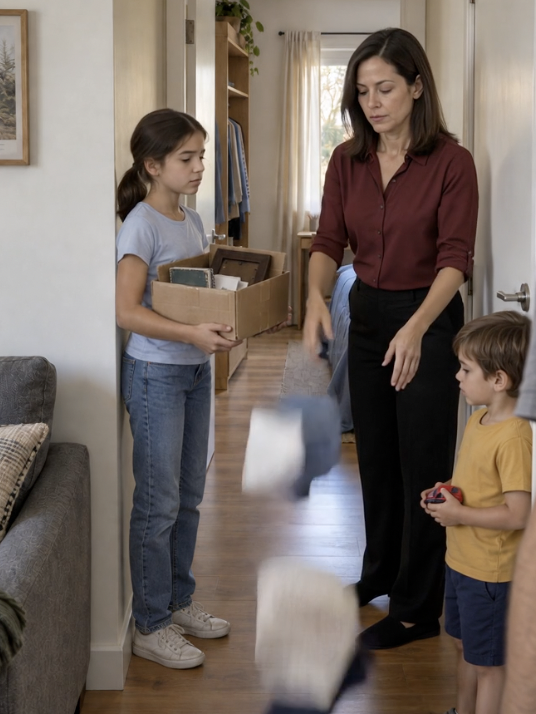
Renata pulled the final stack of clothes from the wardrobe and dropped it into the hallway.
Shirts and trousers scattered across the floor. One landed against Beatriz’s shoe while another caught beneath the bedroom door. The eleven-year-old stood in the middle of the disorder holding a small box against her chest. Inside were photographs, notebooks, and the few possessions connected to her late mother that she did not want anyone else touching.
Renata announced that the room would now belong to Lucas. Beatriz was older, she said, and could sleep in the living room.
Beatriz protested. It had been her bedroom for as long as she could remember. Renata responded that the younger child needed the space more.
When Marcelo appeared in the hallway, Beatriz looked at him with the last of her hope. She expected her father to tell Renata to return everything to the wardrobe.
Instead, he told Beatriz to stop arguing. Lucas was younger. That was enough explanation for him.
Lucas stood several steps behind his mother, holding a small toy car he had taken from Beatriz’s desk. He looked uncomfortable, but he said nothing and did not put it back.
The bedroom was only the latest loss.
First there had been a backpack. Then a pencil case. Then a birthday present Lucas decided he liked. Every request followed the same path. Renata reminded Beatriz that she was older, that Lucas was her brother, and that refusing would be selfish. Marcelo usually ended the disagreement with a sentence meant to make the matter sound too small to resist.
It was only one object.
But the objects never stopped.
Beatriz knelt beside the box to protect a framed photograph before Renata decided it also belonged somewhere else. As she moved several papers, a yellowed envelope slipped through an opening in the side and landed on the floor.
Marcelo saw the signature on the back and became still.
He asked where it had come from. Beatriz reached down first and said it had belonged to her mother. Renata extended her hand, but Beatriz pulled the envelope closer.
Marcelo took it gently, opened it, and unfolded several pages. His expression changed as he read. He returned to the beginning, then moved through the pages again as though hoping a second reading would produce a different meaning.
Renata demanded an explanation.
Marcelo said the apartment could not have been used in the way they had been using it.
The document had been prepared years earlier. Beatriz’s mother had contributed to the purchase of the apartment. Before her death, she had established that her share in the property should help guarantee stable housing for her daughter until Beatriz reached adulthood. Marcelo had been given responsibility for administering that protection.
The word was administering—not owning without limitation and not deciding that Beatriz’s right to live there depended on whether the adults found her convenient.
Beatriz did not understand every legal phrase, but she understood the section Marcelo read twice. The home was supposed to preserve stability for her.
Renata crossed her arms and pointed out that the document did not guarantee Beatriz a particular bedroom.
Marcelo agreed.
For a moment, Beatriz thought the papers would change nothing.
Then her father said the document made clear that they could not treat her presence in the apartment as a favor that might be withdrawn whenever someone else wanted more space.
Renata called the papers old and accused Marcelo of creating drama. She tried to take them, but he moved them out of reach and said he needed to read everything before anyone touched another item in the room.
It was the first time that evening Marcelo used the firm tone he normally directed at Beatriz to stop Renata instead.
Beatriz noticed.
So did Renata.
The room had not yet been returned permanently. Nothing had truly been resolved. The envelope did not make Beatriz the owner of the entire home, nor did it erase the needs of the other people living there.
But it interrupted a decision everyone had expected her to accept without question.
For the first time in years, the burden of keeping the household calm did not automatically fall on the child who was least likely to shout.