Chapter 1
## The Photograph Caleb Sent
Room 214 had never felt so quiet.
Twenty-eight eighth-graders sat at their desks while thirteen-year-old Malik Carter stood near the front of the classroom, trying not to look at the faces behind him.
Mrs. Baxter held a wooden ruler.
Malik had always been one of the quieter students at Easton Preparatory. He completed his assignments, rarely caused trouble, and usually stayed away from classroom arguments. That afternoon, however, he had become the center of one.
The disagreement had begun with a grade.
Months earlier, Mrs. Baxter had given one of Malik’s essays a C-minus. Malik’s mother, Denise Carter, read the paper and compared it with the grading rubric. The score did not seem consistent with the work, so she requested that another teacher review it independently.
The second evaluation came back much higher.
That alone would have been uncomfortable, but Denise also learned that Mrs. Baxter had been using vague measures such as “leadership readiness” and “classroom attitude” in ways that could significantly affect students’ grades.
Denise filed a complaint.
The school handled the matter internally. Mrs. Baxter received administrative coaching, and the complaint became one factor in a leadership opportunity she later failed to receive.
By the time Malik entered Room 214 months later, Denise believed the issue was over.
Mrs. Baxter apparently did not.
Now Malik stood in front of her as she ordered him to put his hand forward.
He hesitated.
“Why?”
Several students looked up.
Mrs. Baxter’s expression hardened.
She told him she would not tolerate disrespect from a student whose family had already caused enough difficulty.
Malik tried to explain that his mother had only questioned a grade.
Mrs. Baxter replied that some families needed to appreciate the opportunities their children had been given instead of constantly challenging the people providing them.
The comment made Malik’s face burn.
As a Black student in a school where wealth, family connections and donor relationships were impossible to ignore, he was already aware of how differently people could interpret the same words. Whether Mrs. Baxter intended the comment as racial, social or personal, Malik felt singled out in front of the entire class.
Then the ruler came down against his hand.
It happened once.
The pain was brief, but the humiliation was not.
Malik pulled his hand toward his chest as his eyes filled with tears.
Near the middle of the room, Caleb Brooks pushed his chair back.
“Why are you doing this to him?”
Mrs. Baxter ordered him to sit.
Caleb did not immediately move.
He asked whether Malik was being treated differently because his mother had complained—and whether something else about Malik was affecting how she saw him.
Mrs. Baxter responded with a warning of her own.
Caleb’s final grade, she reminded him, was still under her control.
That was enough to make him sit down.
But it was not enough to make him stop.
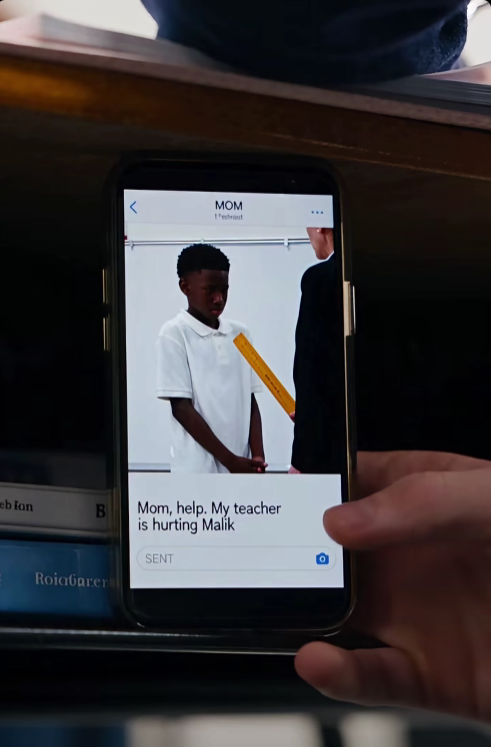
When Mrs. Baxter turned toward Malik again, Caleb slid his phone partly beneath a textbook.
He raised the camera only a few inches.
One photograph.
The sound was small.
A click.
Mrs. Baxter spun around.
“Who took that?”
No one answered.
As she ordered students to place their phones where she could see them, Caleb worked beneath the edge of his desk.
He attached the photograph to a message for his mother, Laura.
He did not write an essay.
He simply told her that something was wrong and that Mrs. Baxter had struck Malik.
Then he pressed send.
Four miles away, Laura Brooks opened the image.
Within minutes she was calling Denise.
Denise was still at work at St. Luke’s Hospital when the photograph arrived on her phone.
She recognized her son immediately.
Malik was standing beside Mrs. Baxter, one hand pulled close to his chest. His eyes were wet. The wooden ruler was visible.
Denise stared at the screen.
Then Laura told her the confrontation appeared to be connected to the old grade dispute.
That changed everything.
Denise left for Easton.
By then the school had already been alerted.
Assistant Principal Warren Pike entered Room 214 and asked what had happened.
Mrs. Baxter said Malik had become disrespectful.
Caleb immediately challenged that account.
Pike silenced him and began speaking quietly with Mrs. Baxter about preventing the situation from growing.
Malik heard enough to understand the priority.
The first conversation was not about whether he had been treated properly.
It was about containing the problem.
Twenty minutes later, Denise arrived.
She did not shout.
She did not threaten anyone.
She checked Malik’s hand, made sure he was physically all right, and then asked school administrators to preserve everything connected with the incident: classroom footage, student statements, grade records, system logs and Mrs. Baxter’s recent account activity.
Principal Evelyn Shaw immediately recognized that this was no longer an ordinary parent conference.
Mrs. Baxter did too.
She reminded everyone that her family had supported Easton for decades.
Her husband, Grant Baxter, was a respected attorney. Her father-in-law, Charles Baxter, had been deeply involved with the Easton Education Foundation. The Baxter name was familiar throughout the school.
Mrs. Baxter seemed to believe that history mattered.
Then the conference-room door opened.
A seventy-two-year-old Black man in a charcoal suit entered quietly.
Principal Shaw recognized him at once.
Leonard Carter.
Founder of Carter Meridian Group and head of the Carter Education Trust, an organization that had funded scholarships, libraries, teacher programs and part of Easton’s new science facilities.
Mrs. Baxter knew his face too.
What she had not known was why he was there.
Leonard crossed the room and stopped beside Malik.
He asked his grandson whether he was all right.
For the first time that afternoon, Mrs. Baxter appeared uncertain.
Malik Carter was Leonard Carter’s grandson.
Denise was the widow of Leonard’s eldest son.
None of that should have mattered to the way Malik had been treated.
But judging from Mrs. Baxter’s expression, it did.
Leonard did not demand that anyone be fired.
He did something much less dramatic.
He asked for an independent review.
Until that review was complete, the Carter Education Trust would temporarily pause a pending multimillion-dollar contribution to Easton.
If the school’s procedures had worked properly, he said, the funding could resume.
If they had not, he wanted to understand what kind of institution the trust was supporting.
Before the meeting ended, Principal Shaw’s phone received a system alert.
Malik’s writing portfolio had been graded 92.
Now it showed a zero.
The new entry suggested an academic-integrity concern.
The change had been made after Mrs. Baxter learned that Denise was at school.
There was no plagiarism report.
No new evidence.
Only a timestamp.
The photograph had shown what happened inside Room 214.
The gradebook was about to show what happened after.