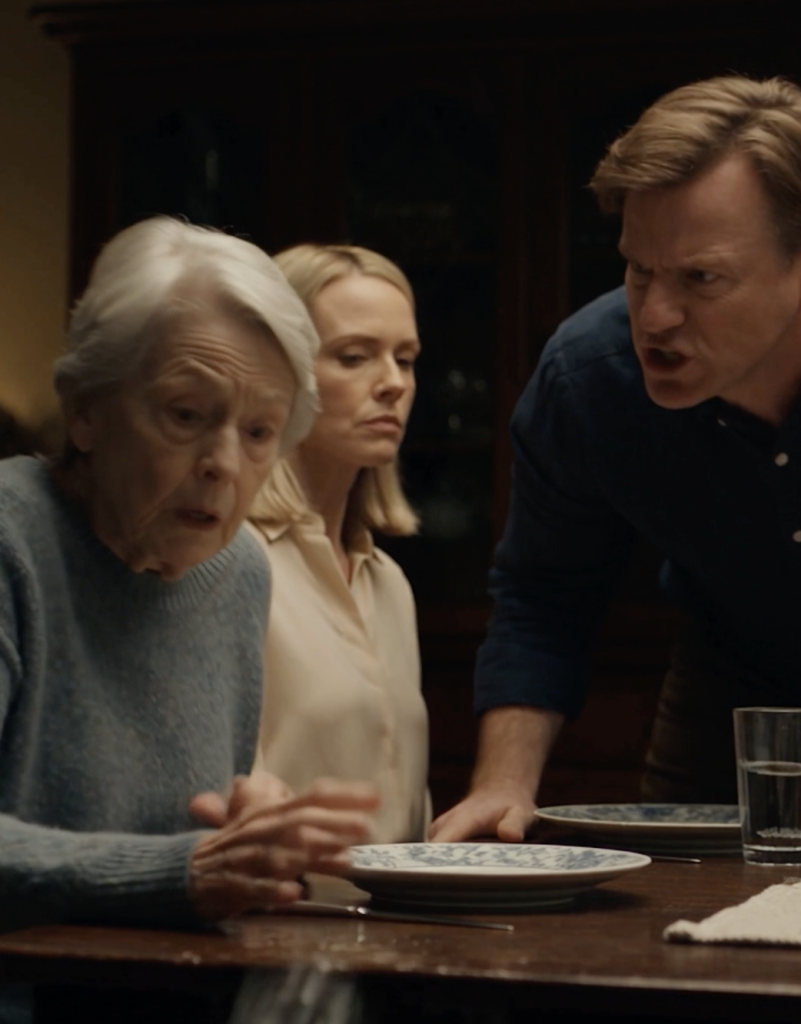
Chapter 1
The Envelope Beneath Her Chair
“Can you stop ruining everything for once?”
Daniel Hale’s palm struck the dining table hard enough to rattle every plate.
Water spread across the white tablecloth and dripped onto the floor. Margaret Hale froze with the empty pitcher still in her hand.
“I’m sorry,” she said. “My hand slipped.”
“Your hand always slips. You always forget. You always drop something.”
Daniel pushed his chair back and stood over her.
“It’s one glass of water,” eleven-year-old Sophie said quietly.
Daniel turned toward his daughter.
“Stay out of it.”
Sophie lowered her eyes, but only for a moment.
It was Margaret’s seventy-second birthday. She had cooked the roast, set the table and placed flowers in the blue vase her late husband had given her.
No one had brought a cake.
No one had brought a card.
Sophie was the only person who had wished her a happy birthday without being reminded. At the far end of the table, the chair that once belonged to Robert remained empty.
“Leave it,” Daniel said as she bent to wipe the floor. “You’ll only make a bigger mess.”
Margaret lowered herself carefully onto one knee.
“Mom, get up,” Claire said, but there was no tenderness in her voice. “This is exactly what we’ve been talking about.”
Margaret looked at her daughter.
“What have you been talking about?”
Claire and Daniel exchanged a quick glance.
“We can’t keep pretending everything is fine,” Claire said.
“Then say what you mean.”
“You lose things. You miss medication. You accuse people of moving your belongings.”
“Because things have been moved.”
Daniel gave a tired laugh.
“Nothing is ever your fault.”
Sophie left her chair and knelt beside her grandmother.
“I’ll help you.”
“Go sit down,” Daniel ordered.
“Grandma didn’t do anything.”
“You’re making her birthday awful.”
Margaret touched the girl’s wrist.
“It’s all right, sweetheart.”
“No, it isn’t.”
Sophie took the towel and began blotting the floor.
“Maybe it’s time we discussed assisted living.”
The room became still.
Margaret slowly turned toward her daughter.
“A nursing home?”
“A community,” Claire corrected. “Somewhere safe.”
“I thought this was my home.”
Daniel gave a humorless laugh.
“This is my home, Mom.”
Six months earlier, Margaret had sold the house where she and Robert raised their children. Daniel persuaded her to move in and accepted ninety-two thousand dollars to clear several debts and convert his study into her bedroom.
The room was never built. Margaret slept beside the laundry closet while her furniture remained boxed in the garage.
Margaret rose with Sophie’s help.
“You’re right,” she said.
Daniel blinked. Her calmness unsettled him.
“Right about what?”
“This arrangement cannot continue.”
Claire’s expression softened with relief.
“We knew you would understand.”
Margaret reached for her chair. A sealed white envelope slipped from her cardigan and fell onto the wet floor.
Daniel saw it first.
He picked it up before Margaret could bend down.
Across the front, in black printed letters, were the words:
CONFIDENTIAL COGNITIVE AND CAPACITY EVALUATION — MARGARET E. HALE
Daniel looked at Claire. Neither managed to hide the satisfaction in their eyes.
“You had an evaluation?” Claire asked.
Margaret extended her hand.
“That is private.”
Daniel held the envelope away from her.
“Not if we’re the people responsible for taking care of you.”
“Give it back.”
“If a doctor says you need help, we have a right to know.”
“You do not have the right to open my mail.”
Daniel tore the envelope across the top.
Sophie stood.
“Dad, Grandma said no.”
He ignored her and unfolded the report.
Claire moved beside him, reading over his shoulder.
Margaret returned to her chair. For the first time that evening, she looked entirely unafraid.
Daniel scanned the first paragraph.
The confidence drained from his face.
Claire reached for the page.
“What does it say?”
He did not answer.
“Daniel?”
Claire pulled the report closer and read aloud:
“Mrs. Hale demonstrates intact memory, sound judgment and full capacity to manage her personal, medical and financial affairs. I find no clinical evidence of dementia or cognitive impairment.”
Silence filled the dining room.
Sophie looked at her grandmother.
Daniel flipped through the remaining pages.
“Why would you have this done?”
“Because someone kept telling people I was losing my memory.”
“Who?” Claire asked too quickly.
“Turn the page.”
Daniel did.
Attached to the doctor’s report was a letter bearing the name of an elder-law attorney.
His eyes stopped on the second paragraph.
Margaret folded her hands in her lap.
“That evaluation was never about proving something to me,” she said. “It was about proving what the two of you have been doing.”
Daniel’s fingers tightened around the paper.
Near the bottom, beneath the words DOCUMENTED FINANCIAL AND PSYCHOLOGICAL COERCION, was a list of names.
His appeared first.