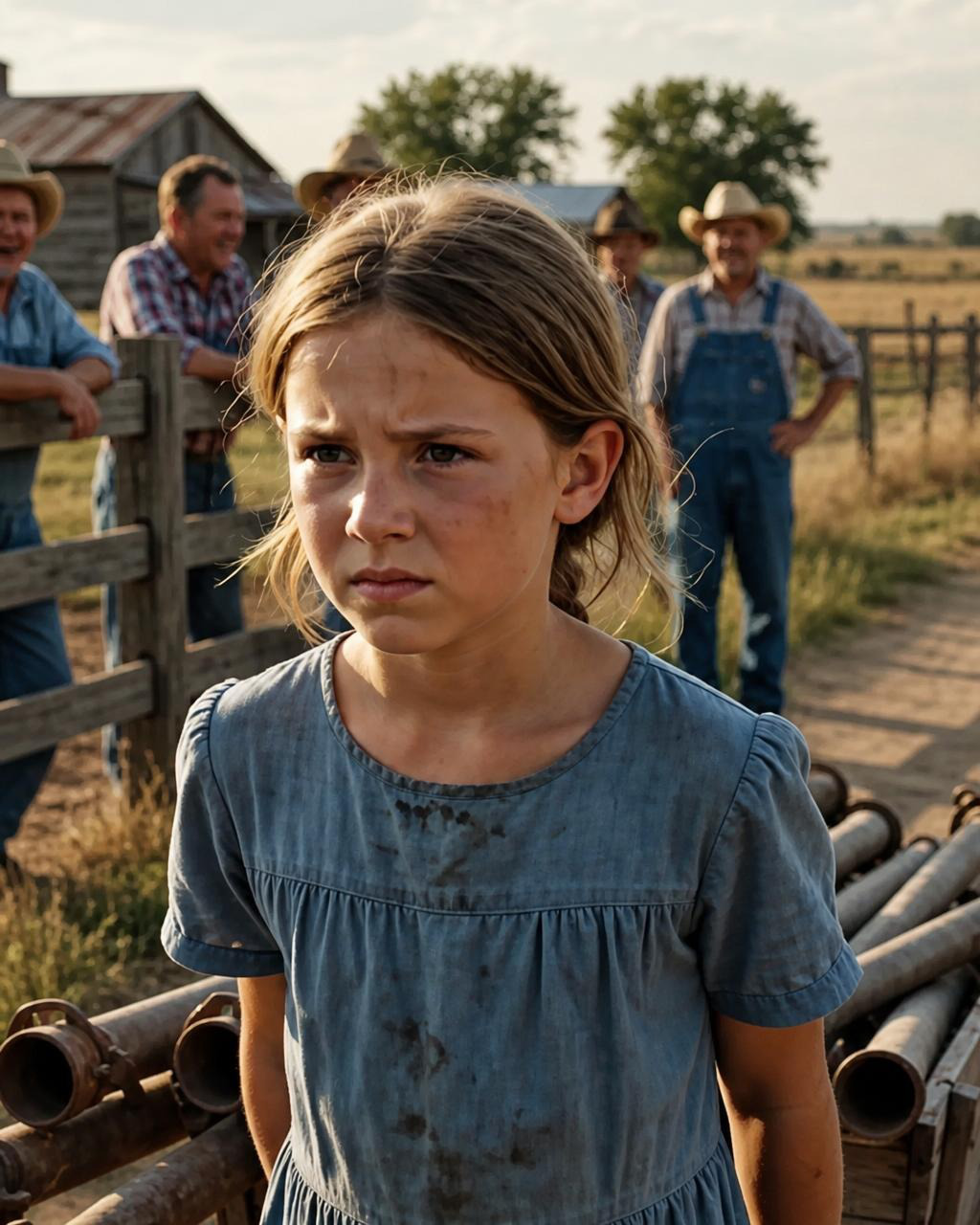
The first time Clara pulled the wagon through town, people thought she was collecting firewood.
Then they looked closer.
The wagon was filled with cracked irrigation pipes, rusted metal joints, bent connectors, and short pieces of black tubing that had been lying behind Mr. Dawson’s barn for years.
Most of it was covered in dirt. Some pieces were split down the middle. Others had roots growing through them.
To everyone else, it was junk.
To Clara, it looked like a beginning.
She was only eleven years old, small enough that the wagon handle nearly reached her shoulders. Each time one of the wheels became trapped in the dry ruts of the road, she leaned forward with all her weight and pulled until it moved again.
Two farmers sitting outside the feed store watched her pass.
“What are you building, Clara?” one of them called.
“A way to save our field,” she answered.
The men looked toward the land behind her family’s house.
For three months, rain had barely touched the valley. The creek had narrowed into a muddy line, and the grass had turned the color of old rope. Clara’s mother had already stopped planting most of the field because the well could no longer provide enough water.
One of the farmers shook his head.
“You cannot save a field with broken pipes.”
Clara kept walking.
Her family’s farm had never been large. There were no expensive machines, no deep irrigation wells, and no workers to help when the weather turned against them.
There was only Clara, her mother, and a few acres of tired ground that had once belonged to Clara’s grandfather.
He had taught her how to press seeds into the earth with her thumb. He had shown her that soil was not dead simply because it looked empty.
“Land remembers kindness,” he used to say. “You just have to give it a reason to trust you again.”
But her grandfather had been gone for two years, and the field seemed to be forgetting everything he had taught them.
By early summer, most of the young plants had begun to wilt. Clara’s mother carried buckets from the well each morning, pouring a little water around every row, but the soil drank it almost immediately.
“We may have to let the field rest,” her mother finally said.
Clara understood what that meant.
There would be no vegetables to sell at the roadside stand. No jars of tomatoes in the pantry. No extra money for winter repairs.
That evening, Clara walked through the dry rows alone.
She noticed that the plants beneath the old wooden fence were greener than the others. The fence cast a narrow shadow during the hottest part of the afternoon, slowing the water that disappeared from the soil.
That small patch of shade gave Clara an idea.
The next morning, she visited every nearby farm and asked whether anyone had old irrigation materials they no longer needed.
Most people said no.
Some laughed.
Mr. Dawson pointed toward a pile behind his barn.
“You can take anything from there,” he said. “But none of it works.”
Clara spent the entire day sorting through the pile. She chose the longest pieces of pipe, several damaged hoses, a roll of baling wire, and old cloth seed sacks that had been thrown away.
It took her three trips to bring everything home.
For the next week, Clara worked before sunrise and after the heat faded in the evening.
She cut the broken pipes into shorter sections. She pushed both ends into the ground, bending them into arches above the weakest rows. She tied the arches together with baling wire, then stretched old seed sacks across the top to create narrow tunnels of shade.
The structure looked uneven and strange.
Some arches leaned to one side. The cloth was made from different colors and materials. A few pieces carried the faded names of feed companies that no longer existed.
The farmers passing on the road noticed immediately.
One man stopped his truck and stared.
“That thing will blow away in the first strong wind,” he said.
Another asked whether Clara planned to grow vegetables or hide them.
Clara did not argue.
She still had another problem to solve.
The well could provide a small amount of water, but carrying buckets to every plant wasted too much of it. Clara needed the water to move slowly and directly toward the roots.
She examined the damaged hoses she had collected. Most were useless as regular irrigation lines because they contained dozens of tiny holes.
But Clara realized the holes might be exactly what she needed.
She connected the hoses to an old barrel beside the house and raised it onto a wooden platform. Her mother helped fill the barrel with water from the well.
When Clara opened the valve, the water moved through the hoses by gravity.
At first, it poured too quickly from one end and barely reached the other. Clara closed the valve, adjusted the height of the barrel, and blocked some of the larger holes with pieces of cloth.
She tried again.
This time, small drops appeared along the entire length of the hose.
The water did not flood the rows. It did not disappear across the hard surface.
It fell slowly beside each plant, soaking directly into the roots.
Clara smiled.
For the first time in weeks, the soil beneath the plants remained dark long after the sun rose.
The system was far from perfect. Connections leaked. Cloth tore during windy nights. Rabbits chewed through part of one hose, and Clara had to repair it with wire and tree sap.
But every morning, she returned to the field.
She tightened the arches, patched the shade covers, and moved the hoses wherever the soil looked driest.
Gradually, the plants changed.
Their leaves lifted.
New flowers appeared.
Tiny green tomatoes formed beneath the shade, followed by beans, squash, and rows of peppers.
Outside Clara’s covered rows, the valley continued to turn brown.
The grass disappeared from the roadsides. Several neighboring farmers harvested early, accepting smaller crops before the drought destroyed what remained.
But behind Clara’s house, a strip of green continued to grow.
By the end of August, it could be seen from the road.
One evening, the farmer who had laughed at Clara outside the feed store stopped beside the field.
He climbed from his truck and walked toward the strange structure of broken pipes and faded cloth.
Clara was kneeling near the barrel, repairing another leak.
The man lifted the edge of one of the covers.
Beneath it were rows of healthy vegetables, their leaves cool and green in the softened light.
For several seconds, he said nothing.
Then he removed his hat.
“How much water are you using?” he asked.
“Less than half of what we used before,” Clara said.
The farmer looked again at the old hoses, the rusted connectors, and the pipes everyone had called worthless.
“My field is nearly gone,” he admitted.
Clara stood and brushed the soil from her knees.
“There are more broken pipes behind Mr. Dawson’s barn,” she said. “I can show you how to use them.”
Within days, other farmers began visiting Clara’s field.
They arrived quietly at first, embarrassed by the jokes they had made. Clara showed them how to build low shade tunnels, how to raise water barrels, and how to turn leaking hoses into simple drip lines.
No one called the pipes junk anymore.
That autumn, Clara and her mother filled their roadside stand with vegetables from the only rows in the valley that had remained green all summer.
They did not become rich.
The drought did not disappear.
But they kept their farm.
And beside the barn, Clara saved the final unused piece of cracked irrigation pipe.
Her mother asked why she did not throw it away.
Clara placed it above the doorway of the small shed where they stored seeds.
“So we remember,” she said.
“Remember what?”
Clara looked across the field, where green leaves still moved beneath arches made from things no one else had wanted.
“That something does not have to be perfect to become useful again.”
Sometimes, the thing everyone throws away is exactly what someone else needs to begin again.