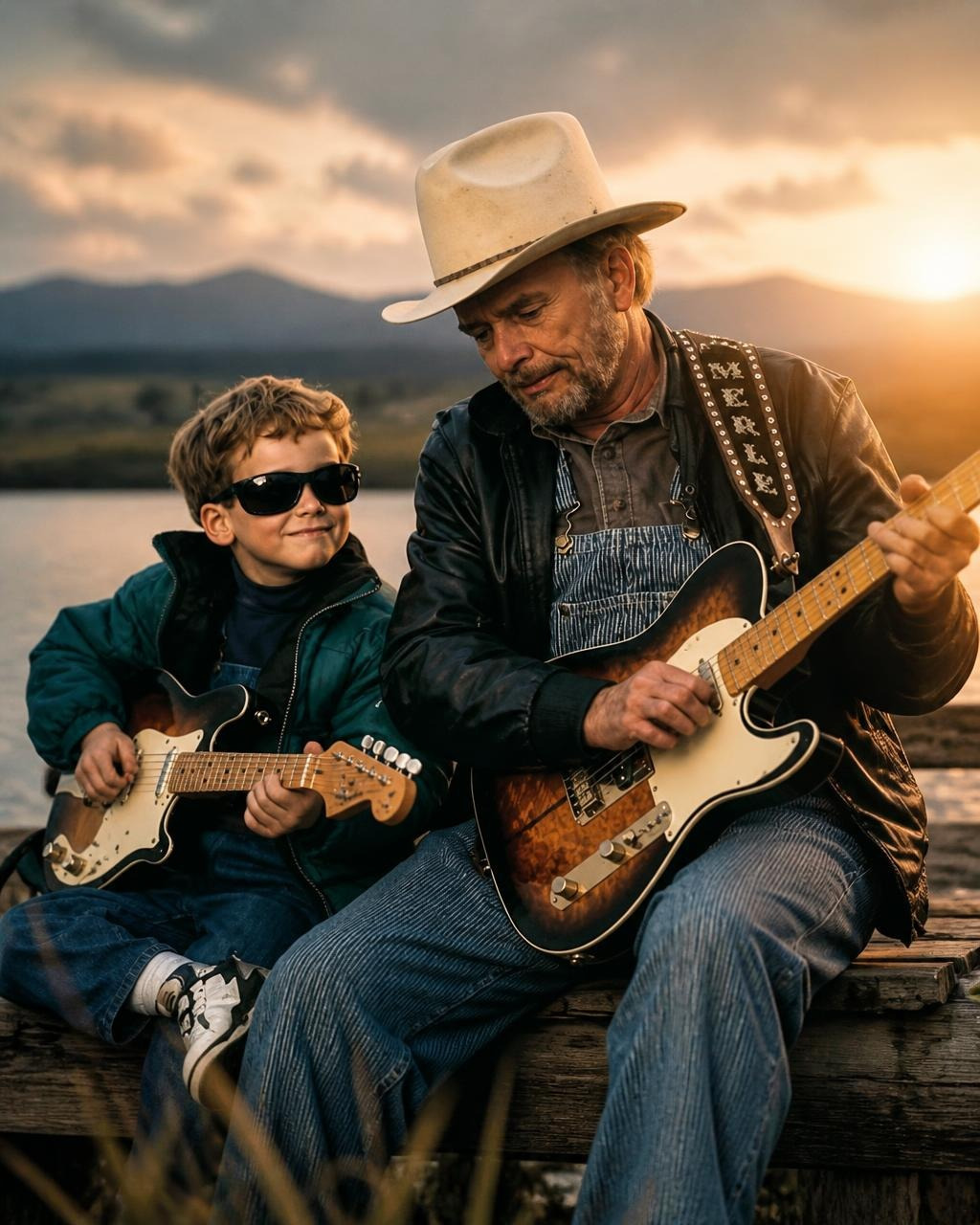
Merle Haggard’s Real Inheritance Lives in Ben Haggard’s Hands
On April 6, 2016, Merle Haggard died at his California home from complications of pneumonia. He was 79, and the date carried a painful symmetry: it was also his birthday. By then, Merle Haggard had already secured his place in country music history as one of the voices behind the Bakersfield sound, with songs like “Mama Tried,” “Sing Me Back Home,” and “Workin’ Man Blues.” His name belonged to the great story of American music.
But the most personal part of Merle Haggard’s legacy did not arrive in a trophy case or a formal announcement. It showed up in the way his youngest son, Ben Haggard, held a guitar.
A son who learned by watching
Ben Haggard did not grow up under pressure to become a performer. He later said that Merle Haggard never forced music on him. That mattered. It meant Ben Haggard came to the instrument through curiosity, not obligation. Around the age of 12 or 13, Ben Haggard began taking guitar seriously, and before long, the music that had filled his childhood became part of his own future.
By 15, Ben Haggard was playing lead guitar in Merle Haggard’s longtime band, The Strangers. That was no small step for a teenager. Night after night, Ben Haggard stood close enough to study timing, phrasing, and the subtle spaces between notes. He was not only playing songs. He was learning how Merle Haggard moved through them.
“He never said, ‘You have to play music.’”
That simple freedom may be the reason the connection feels so lasting. Ben Haggard did not inherit a script. He inherited a living musical language.
After the loss, the songs kept moving
When Merle Haggard died, Ben Haggard was 23. At an age when many people are still trying to figure out who they are, Ben Haggard was suddenly carrying a family name already attached to decades of memory. He kept going anyway. He continued to play, tour, and perform with The Strangers, often alongside his brother Noel, bringing those songs into rooms where Merle Haggard himself could no longer walk.
That is what makes this story linger. A plaque can honor a career. A record can preserve a voice. But a musician’s true inheritance is often quieter than that. It is in the touch of a left hand on the neck of a guitar, in the right hand finding the rhythm, in the confidence to let an old song breathe one more time.
The legacy that cannot be framed
Merle Haggard left behind history. Ben Haggard carries something more intimate: continuity. Not imitation, but a kind of proof that the music still lives inside the family that made it matter in the first place.
Ten years after Merle Haggard’s death, the public memory remains full of achievements and awards. Yet the most moving inheritance may be the least measurable one. Every time Ben Haggard plays, Merle Haggard’s influence appears again — not as a monument, but as sound, skill, and feeling passed from one set of hands to another.